

·
Oct 15, 2026
Finding the Right Surfskate Trucks for Your BIRCH Longboard
At BIRCH Longboards, we offer our boards as deck-only options or as complete setups, ready to hit the pavement. Our complete boards come equipped with standard reverse kingpin (RKP) trucks. They're nothing fancy, and that's kind of the point. RKP trucks are a great all-around choice for longer decks, offering a smooth, predictable ride with plenty of carving ability. They're a solid starting point for cruising, linking turns, and enjoying the simple feeling of riding a longboard.
If you're new to longboarding, a standard BIRCH complete is a great way to get started. You don't need a complicated setup or specialized equipment to have fun. A good set of trucks, the right wheels, and a well-designed deck are all you need to get out there and start riding.
But what happens when you're ready to experiment? Maybe you're looking for tighter turns, deeper carves, or a more surf-like feeling under your feet. Maybe you want to generate speed by pumping rather than pushing, or you're simply curious about how different truck designs can change the way your BIRCH rides.
That's where surfskate trucks come into play.
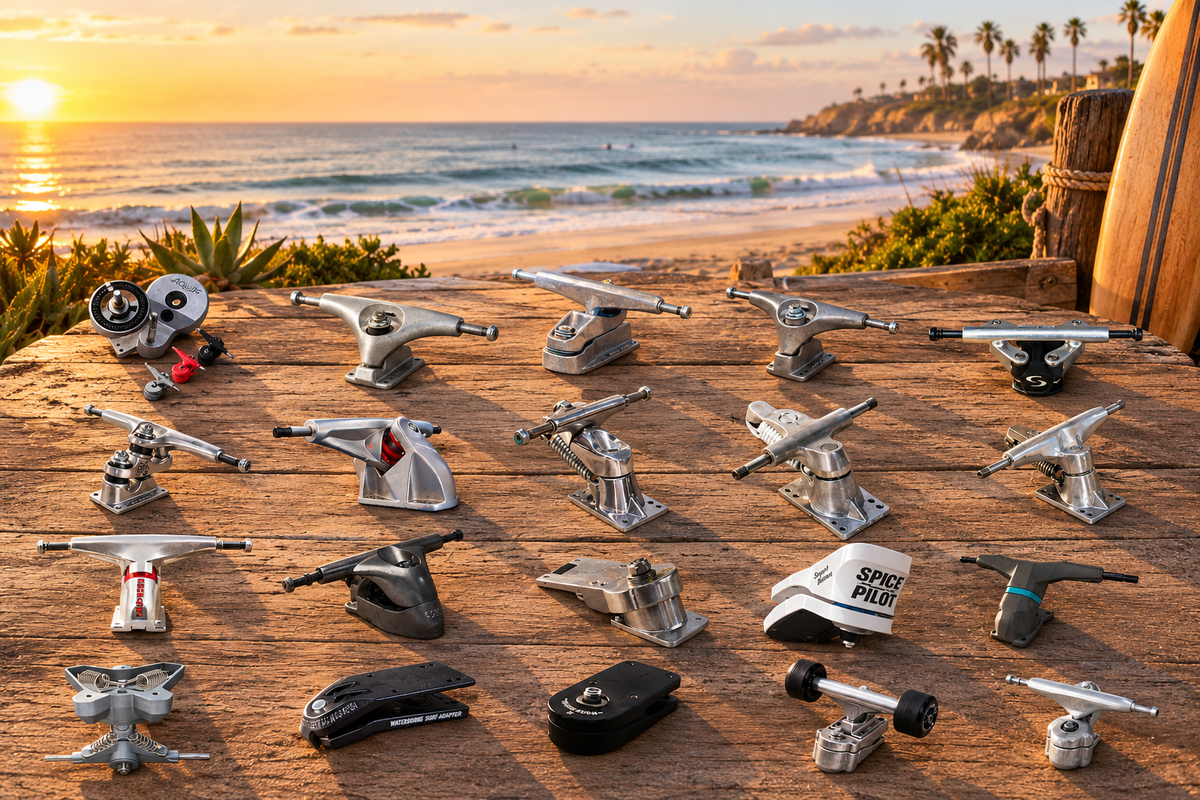
Over the years, manufacturers have developed a variety of truck systems designed to bring the feeling of surfing to the pavement. From spring-loaded mechanisms to specialized truck geometry, each system offers a different approach to turning, carving, and generating speed.
With so many options available, choosing the right setup can feel a little overwhelming. In this guide, we'll explore the history of surfskate trucks, break down some of the most popular systems on the market, and look at which options might work best for your BIRCH longboard.
So which trucks work best on a BIRCH longboard?
A Brief History of Surfskate Trucks
Skateboarding has always shared a connection with surfing. Long before skateparks, technical street skating, and modern longboard designs, surfers were riding skateboards on the pavement when the ocean went flat. The idea was simple: find a way to keep surfing, even when there were no waves.
Traditional skateboard trucks allowed riders to turn, but they didn't provide the same sweeping, flowing movement that surfers were looking for. Riders could carve hills and driveways, but generating speed through pumping and making tight, surf-style turns required something different.
In the mid-1990s, two surfers in Venice Beach, California, Neil Carver and Greg Falk, began experimenting with new truck designs. Their work led to the Carver C7, introduced in 1996. Rather than relying on conventional truck geometry alone, the C7 incorporated a spring-loaded, pivoting arm that allowed the front of the board to move through an additional axis.
The result was a new style of skateboarding that allowed riders to pump for speed, carve deeply, and practice surf-inspired movements on land.
As surfskating grew, other manufacturers developed their own approaches. Some refined spring-loaded systems, while others used specialized kingpin geometry, different pivot arrangements, or adapters that could be installed on conventional skateboards.
Today, surfskate trucks are available for everything from compact, highly maneuverable boards to longer decks designed for cruising, carving, and a more drawn-out surf-like ride.
For a brand like BIRCH, that variety is exciting. A longer deck opens up different possibilities, and the right truck setup can dramatically change the character of the ride.
The Main Types of Surfskate Trucks
Not all surfskate trucks work the same way. Understanding the basic differences makes it easier to find a setup that complements your BIRCH deck.
1. Carver C7 — The Classic Surfskate Feel

The Carver C7 is one of the defining surfskate truck designs. Its spring-loaded, dual-axis mechanism allows the front truck to swing laterally while also leaning through its traditional truck pivot.
This creates a loose, flowing ride that encourages pumping and deep carving. The spring mechanism also provides a return toward center as you transition between turns.
Best for: Riders who want an expressive, flowing ride and a strong surf-training feel.
On a BIRCH: The C7 is worth considering if your goal is to make a longer board feel lively and surf-oriented. On a long deck, its movement can create an interesting combination of a wide platform and a highly responsive front end.
Keep in mind that a very active front truck changes the way the board behaves. Wheel clearance, deck width, mounting position, and rear-truck geometry all matter.
2. Carver CX — Responsive and Versatile

The Carver CX takes a different approach. Rather than using the C7's spring-loaded swing arm, it uses specialized truck geometry and bushings to deliver a wide turning range in a more conventional-feeling package.
The CX is generally more direct and predictable than the C7. It can still carve aggressively and pump, but it also works well for cruising and more traditional skateboarding.
Best for: Riders who want surf-inspired carving with a versatile, relatively straightforward setup.
On a BIRCH: This would be one of the first systems I'd investigate for an all-around BIRCH build. It offers a balance of maneuverability and stability without adding a separate spring mechanism to the front truck.
3. YOW Meraki — Deep Turns and Active Pumping

YOW is another major name in surfskating. Its Meraki system uses a spring-based mechanism to give the front truck substantial movement and help riders generate speed through pumping.
The system is designed around an active surfskate feel, making it appealing to riders who want tight turns, strong front-end movement, and a board that responds readily to shifts in body weight.
Best for: Riders who prioritize surf training, active pumping, and highly maneuverable turns.
On a BIRCH: YOW is worth testing if you want to push the surfskate character of a longer deck. However, the additional movement can make wheelbite a concern, particularly when using large wheels or a deck with limited clearance. Check the complete setup before riding.
4. Waterborne Surf Adapter — A Flexible Conversion Option

Waterborne takes a different approach by offering an adapter that changes the steering characteristics of a skateboard's front truck. A rear adapter is also available for riders who want to modify the back end of the board.
One advantage is flexibility. Instead of purchasing a complete surfskate truck set, riders can use an adapter with compatible conventional trucks and experiment with different combinations.
Best for: DIY builders and riders who enjoy experimenting with their setup.
On a BIRCH: This is an interesting option because BIRCH decks are built around a longer, more traditional longboard format. An adapter can let you explore a surfier ride while retaining the ability to experiment with different truck and wheel combinations.
The trade-off is that adapters change the board's geometry and increase its ride height. Depending on the deck, wheels, and trucks, you may need additional risers or other adjustments to prevent wheelbite.
5. Hamboards HST — A Natural Comparison for Longboards

Hamboards is particularly relevant when discussing surfskating on longer decks. Its HST truck system is associated with the brand's approach to bringing a surf-like ride to oversized skateboards and longboards.
Rather than focusing exclusively on the compact, highly maneuverable boards commonly associated with surfskating, Hamboards offers a useful point of comparison for riders who want a larger platform and a drawn-out carving experience.
Best for: Riders interested in a surf-inspired ride on a longer, more substantial board.
On a BIRCH: Hamboards is worth including in the conversation when evaluating setups for longer BIRCH shapes. The important question is how the complete combination of truck geometry, deck length, wheelbase, and rider stance works together.
Compatibility and mounting dimensions should be confirmed before choosing a particular HST setup.
Other Systems Worth Exploring
The surfskate market also includes Smoothstar, Slide, SwellTech, and other specialized truck designs. Each takes a slightly different approach to steering, pumping, and surf simulation.
Some are designed for very pronounced front-end movement and surf training, while others offer a more conventional carving experience. Not every system will be equally well suited to a longer BIRCH deck, so the best approach is to evaluate each system on its own merits rather than assuming that the most aggressive truck is automatically the best choice.
Which Surfskate Trucks Work Best on BIRCH Longboards?
This is where things get interesting.
A surfskate truck that feels fantastic on a short, compact deck may behave very differently on a longboard. Deck length, wheelbase, width, flex, wheel size, and truck placement all influence how a board turns.
With BIRCH, the goal is to complement the longer shape rather than simply bolt on the loosest trucks available.
Here are the setups I'd put at the top of the list.
Best All-Around Option: Carver CX
For riders who want a balance of carving, cruising, and stability, the CX is a strong starting point.
Its bushing-based design provides a direct response, and it doesn't rely on a separate spring-loaded swing arm. That makes it an appealing option for riders who want surf-inspired performance without making the board feel excessively loose.
I'd start here when building a versatile BIRCH setup that can handle everyday riding and long, flowing turns.
Best for a More Traditional Surfskate Feel: Carver C7
If your priority is a more pronounced surf-like movement, the C7 deserves serious consideration.
Its additional axis of motion creates a different sensation from conventional longboard trucks and the CX. It may be the better choice for riders who enjoy pumping, linking turns, and keeping their weight moving through a flowing line.
On a longer BIRCH deck, the combination of a substantial platform and an articulated front truck can be especially interesting.
Best for Experimenting: Waterborne
For builders who like to tinker, Waterborne offers an opportunity to experiment with different truck configurations.
You can explore how traditional kingpin trucks or reverse kingpin trucks behave with the adapter, and how changing wheels, risers, and bushings affects the final ride.
This is an attractive route for anyone interested in developing a more customized BIRCH setup.
Best for Aggressive Surf Training: YOW Meraki
If you want a more active, surf-training-oriented board, the Meraki is worth a look.
Its spring-based design encourages pronounced front-end movement and pumping. The trade-off is that it requires careful attention to wheel clearance and overall setup geometry.
For a longer BIRCH, I'd test this system carefully before settling on a final configuration.
One important note: These are starting-point recommendations based on each system's design and intended ride characteristics, not a claim that every configuration has been tested on every BIRCH deck. The best choice ultimately depends on the individual board and the rider.
Don't Overlook Wheelbase, Risers, and Wheelbite
Choosing the truck is only half the job. The complete setup matters just as much.
Wheelbase: A longer wheelbase generally produces a wider, more drawn-out turning arc, while a shorter wheelbase tends to feel quicker and more responsive. The truck system and mounting geometry can significantly change that behavior.
Risers: Risers provide extra clearance between the wheels and deck. Some surfskate systems sit higher or turn far enough to require additional clearance. A higher setup can also change the rider's stance and leverage.
Wheelbite: Wheelbite occurs when a wheel contacts the deck during a turn. It can abruptly stop the board, so it needs to be addressed before riding. Check clearance under compression and at full steering angles.
Bushings and adjustment: With bushing-based systems, bushing hardness and kingpin adjustment influence how readily the board leans and how quickly it returns toward center. Follow the manufacturer's setup guidance, and make changes gradually.
Truck width: The truck should be appropriate for the deck width and intended riding style. A mismatch can affect leverage, stability, and how the board feels through turns.
On a long BIRCH deck, these details can be the difference between a setup that feels balanced and one that feels awkward or unpredictable.
The BIRCH Approach: Build for the Ride
At BIRCH, we love the connection between skateboarding and surfing. A longboard doesn't need to be complicated to deliver an incredible ride, and the right truck setup can bring out a completely different personality in the same deck.
Some riders will prefer a more stable, traditional longboard feel with smooth carving. Others will want a loose front end that encourages pumping and deeper turns. Neither approach is necessarily better; it comes down to what you want from your board.
If you're starting with a BIRCH longboard, I'd begin by deciding what kind of ride you're after:
-
Cruising and carving: Start by looking at the Carver CX and similar bushing-based systems.
-
Flowing turns and surf-inspired pumping: Compare the Carver C7 and YOW Meraki.
-
Custom builds and experimentation: Explore the Waterborne adapter.
-
Longboard-specific surf feel: Look into systems such as Hamboards HST and verify compatibility with your particular deck.
Most importantly, don't assume that the same setup will work equally well on every board. Test your configuration at low speeds, check wheel clearance, and make adjustments until the board feels predictable and controlled.
Final Thoughts
Surfskate trucks have come a long way since the first experiments in Venice Beach. Today, riders have an incredible range of options, from conventional-looking trucks with specialized geometry to spring-loaded systems designed to reproduce a more pronounced surfing sensation.
For BIRCH longboards, the opportunity is to find the right balance between the freedom of surf-inspired carving and the stability that makes a longer board enjoyable to ride.
I'd put the Carver CX, Carver C7, Waterborne, and YOW Meraki near the top of the list for experimentation, with Hamboards HST also worth investigating for longer-board applications.
There isn't one perfect truck for everyone. The best setup is the one that works with your deck, matches your riding style, and makes you want to keep rolling.
That's what BIRCH is all about: surf-inspired boards, thoughtful design, and the feeling of finding your own line.
Keep carving. Keep surfing. Keep it BIRCH.